Free written scope consultation - allowances, timeline, and change-order rules on paper before a single trade is scheduled
Styles & brands we work with
- Kitchen remodeling
- Bathroom remodeling
- Home additions & ADU
- Roofing
- Windows & doors
- Driveway & pavers
- Fence
See the difference
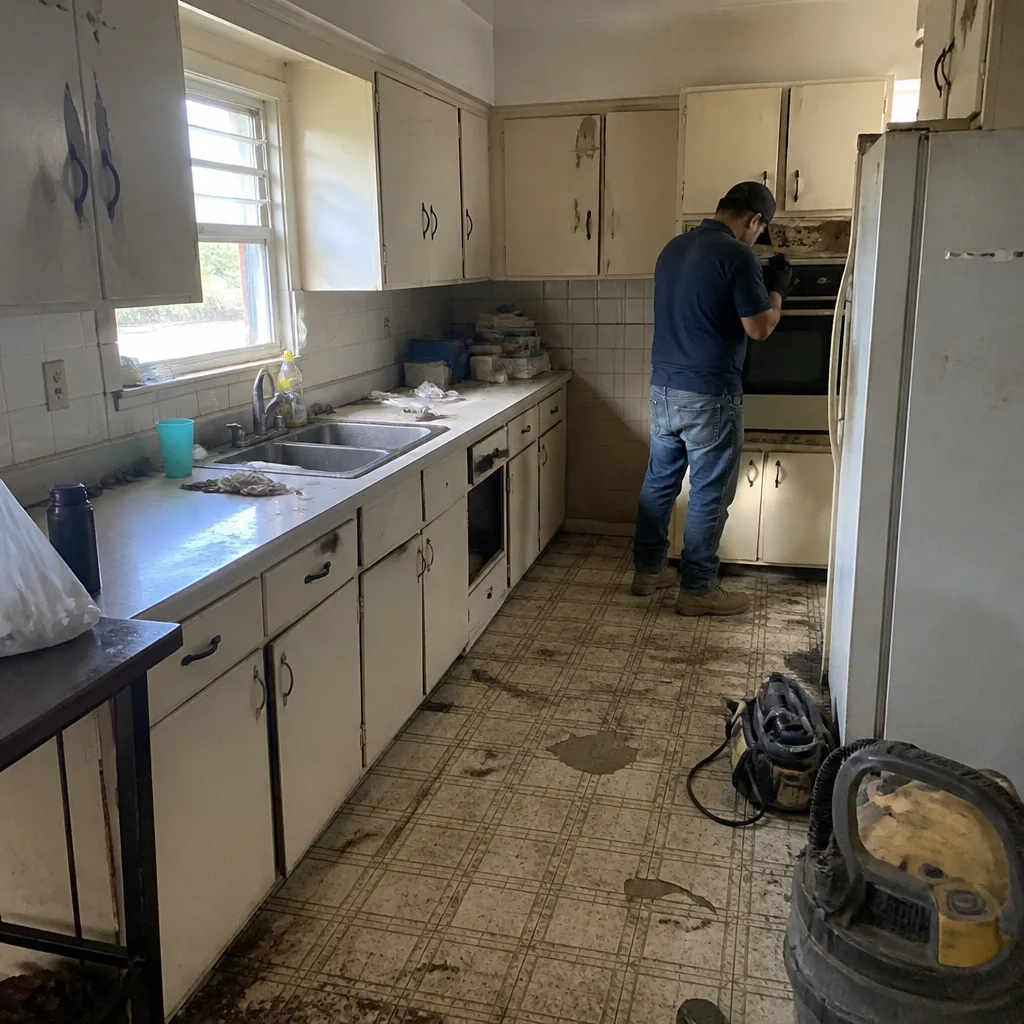 Before
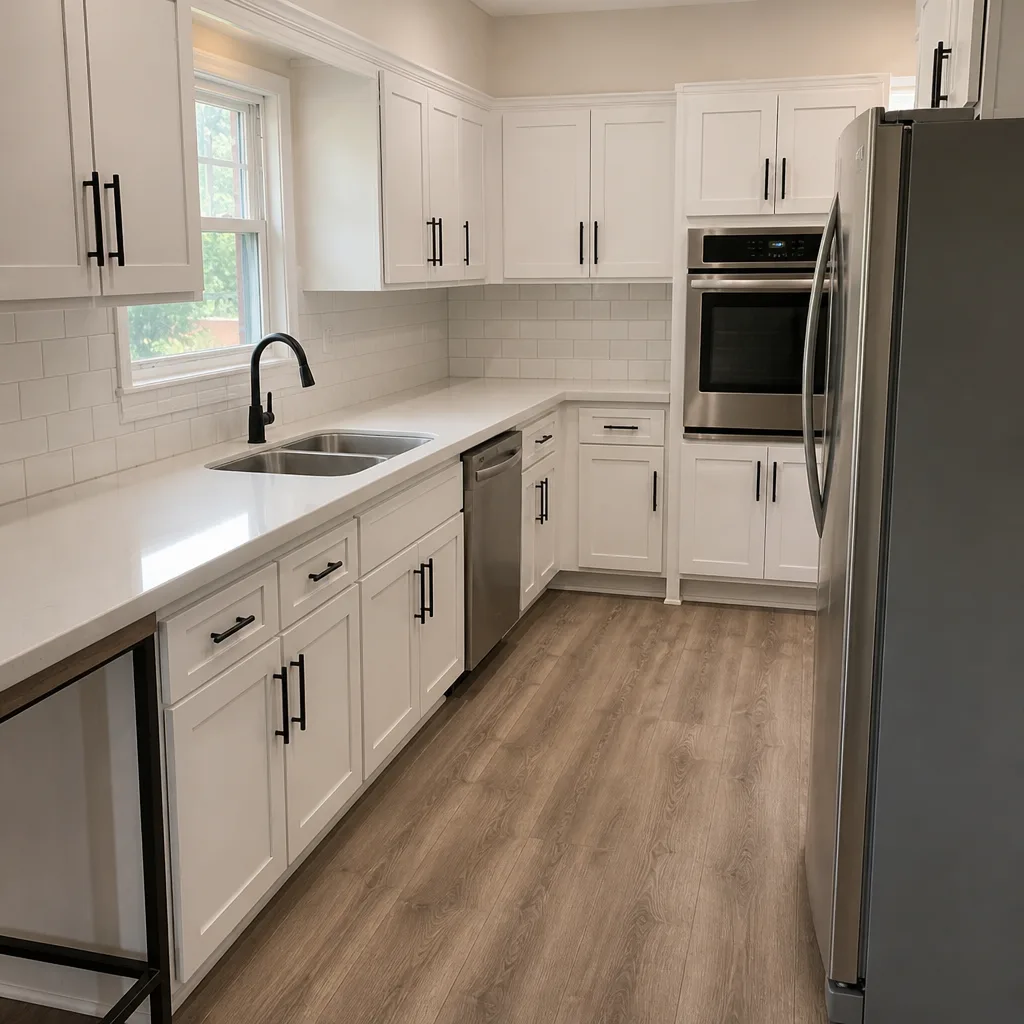 After
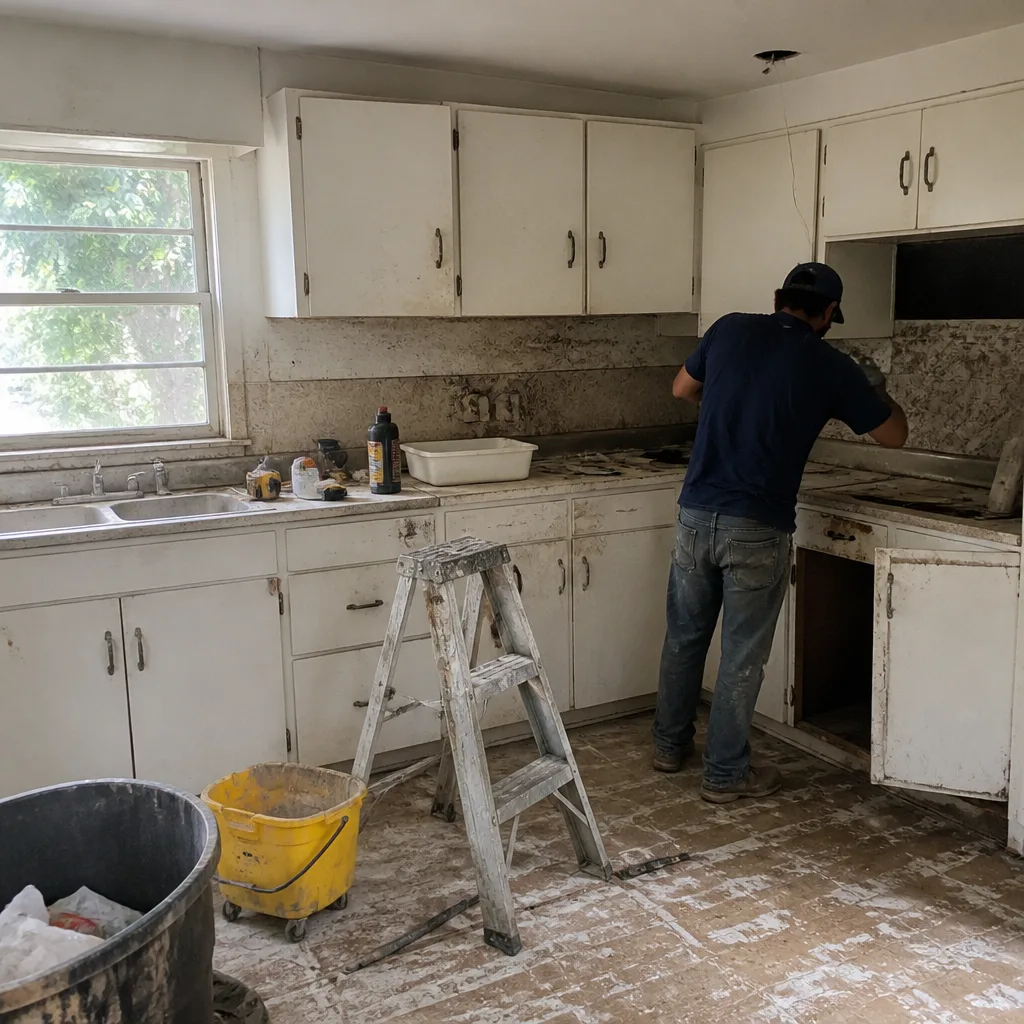 Before
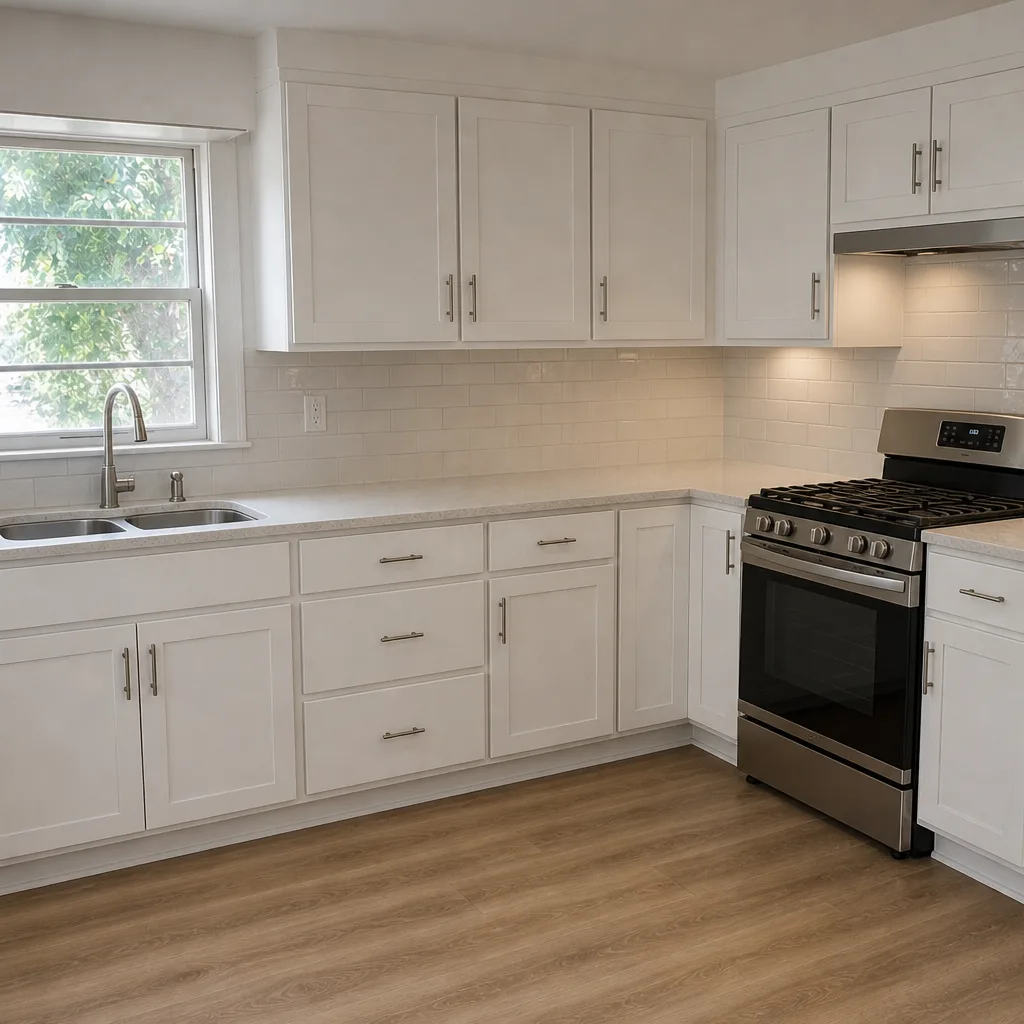 After
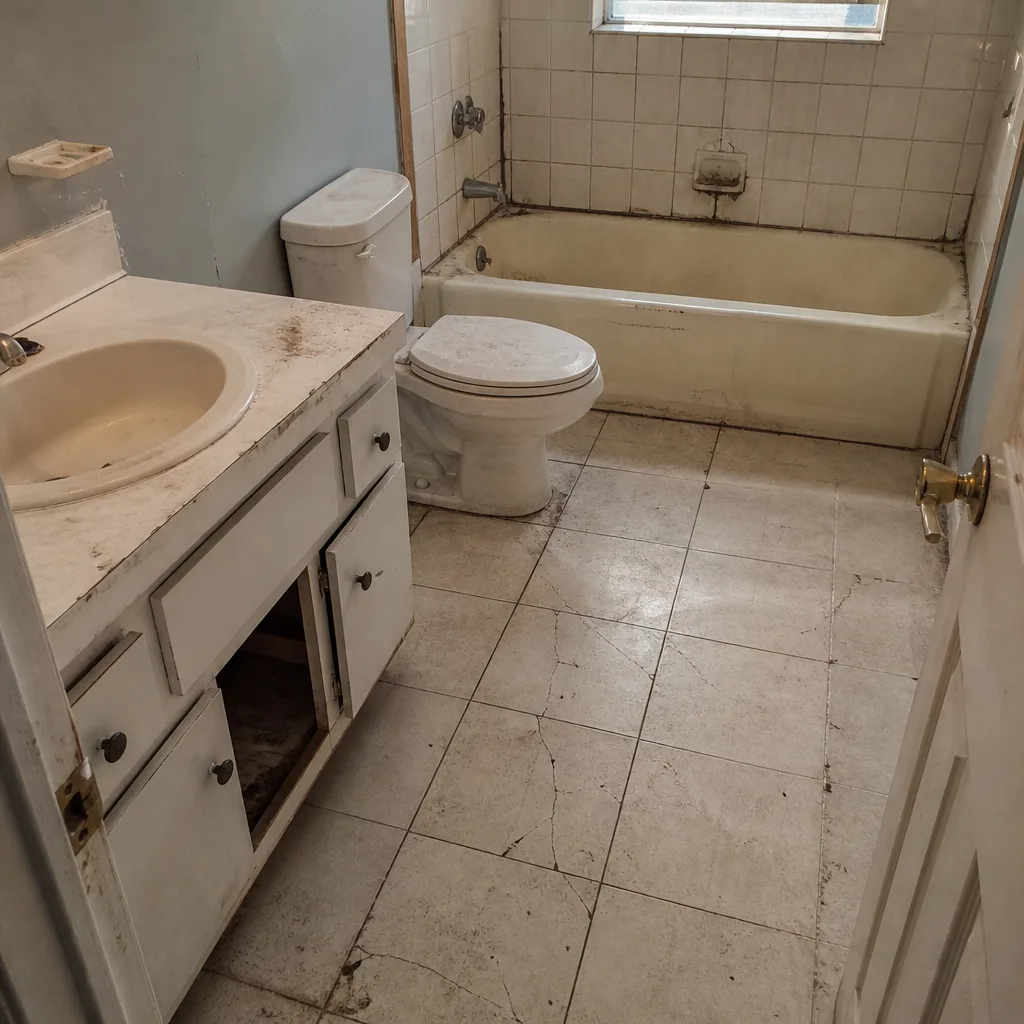 Before
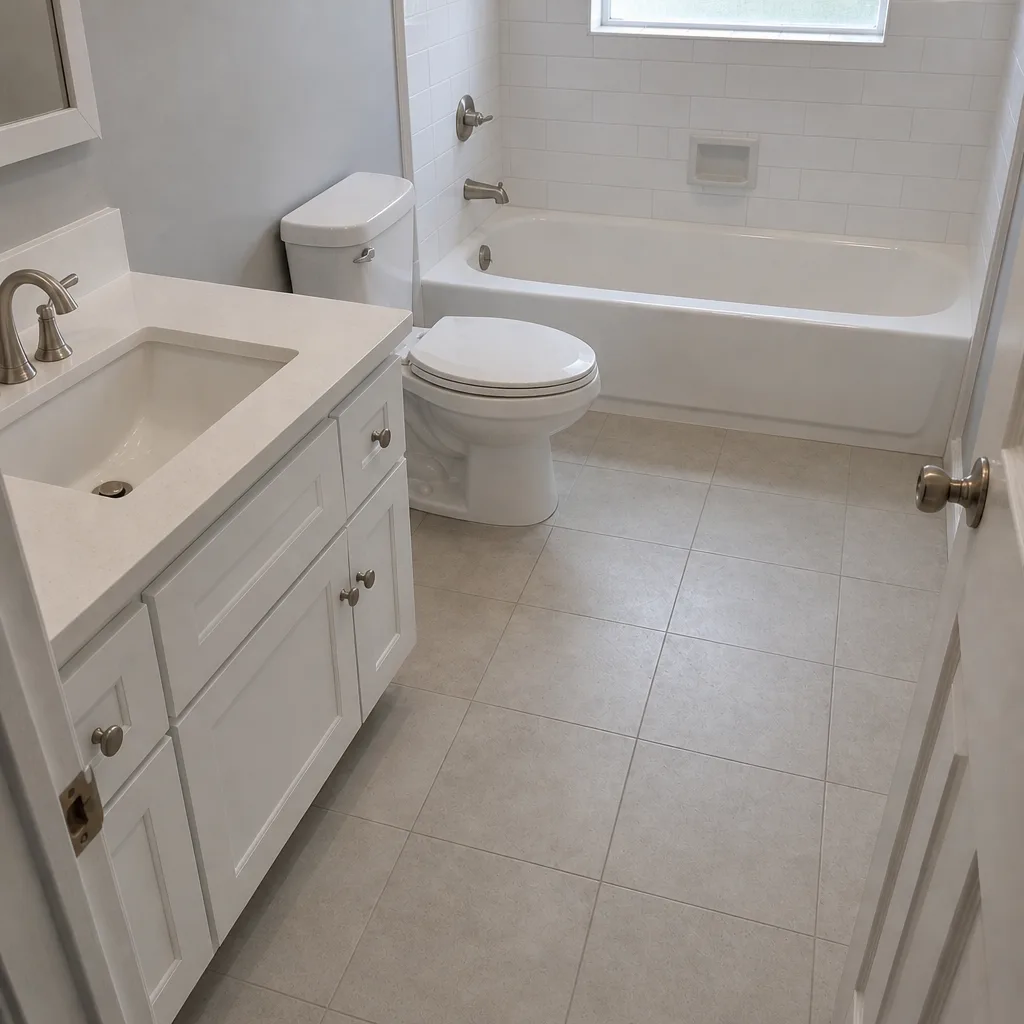 After
Tile vs Vinyl Plank Kitchen Flooring in Westchester, FL: What Your Slab Actually Decides
Choose porcelain tile unless your slab passes a moisture test and you’re installing a rigid-core commercial-grade plank. In Westchester’s concrete-block homes, the tile vs vinyl plank kitchen flooring question is settled less by price than by what’s happening under the floor: ground moisture migrating up through a slab that often has no vapor barrier beneath it. Tile is indifferent to that moisture. Most vinyl plank adhesives are not. Call (833) 630-4214 and we’ll test the slab before anyone commits to a material.
Key Takeaways
- On a slab with a calcium chloride reading above 3 lbs/1,000 sq ft/24 hours, glue-down vinyl plank is a gamble and porcelain tile is the stable answer.
- Quality rigid-core plank (6mm+ wear layer) is a legitimate choice when the slab is dry and there’s a vapor barrier under it.
- Every flooring quote from us starts with a slab moisture assessment, so nobody finds out in year three that the floor was doomed in week one.
Why Westchester Slabs Change the Answer
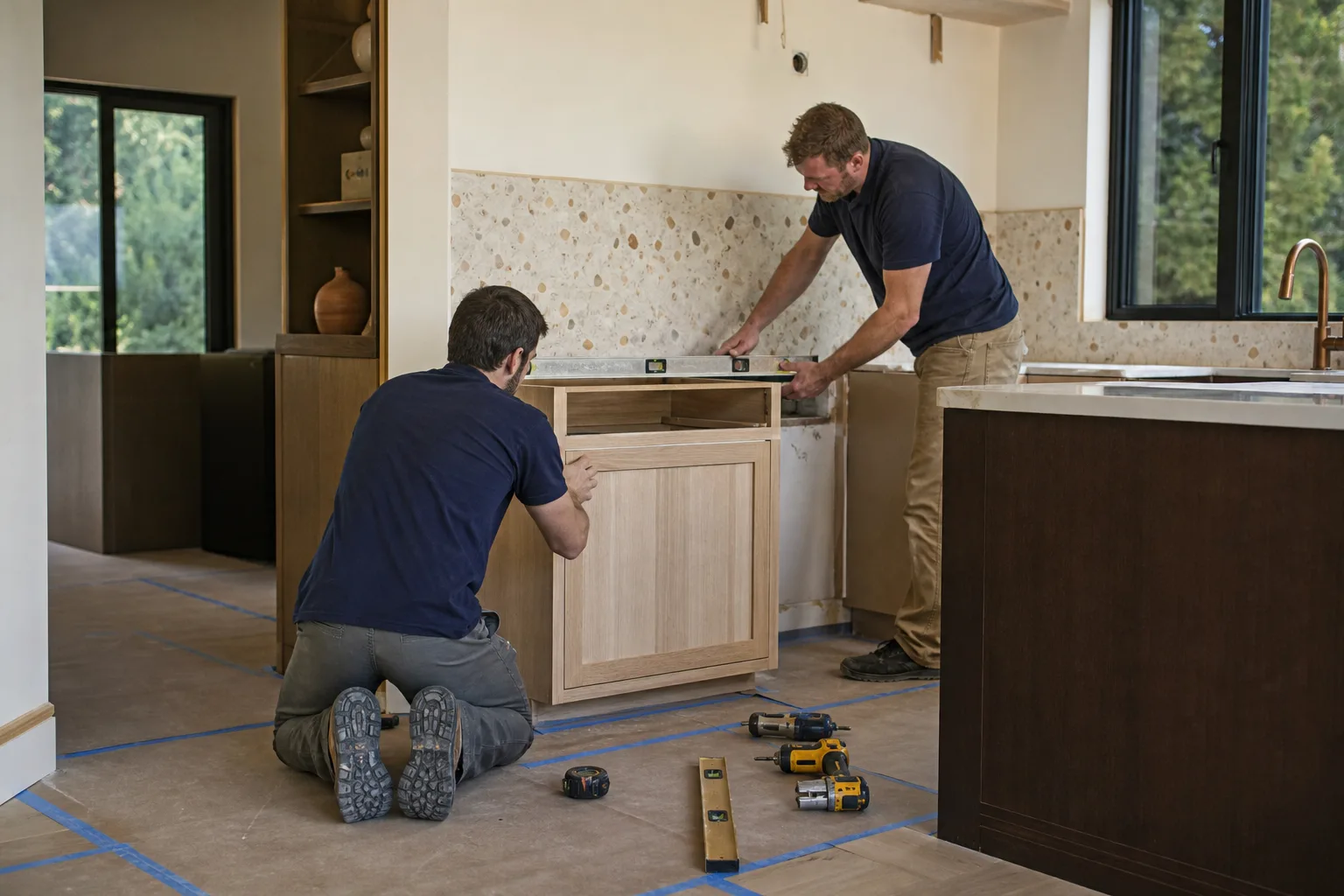
A large share of Westchester homes went up between the 1960s and 1980s, and plenty of those slab-on-grade floors were poured without a continuous vapor barrier underneath. That matters here more than it does in cooler markets, because Miami-Dade’s heat and humidity keep pushing moisture vapor up through the concrete year-round. It doesn’t always show as a puddle. Often it’s invisible vapor transmission that quietly works on whatever adhesive you put on top.
This is where most comparison shopping goes sideways. Vinyl plank wins on sticker price and usually wins on comfort underfoot. Tile wins on moisture tolerance. But which one you should install in a given kitchen depends on a measurement, not an opinion. That’s the tension we walk into on nearly every Kitchen Remodeling project in this part of unincorporated Miami-Dade. Meanwhile the homes themselves – concrete block with stucco exteriors and low or flat roofs – are solid shells that hide floor-level moisture well until a plank floor starts cupping at the seams.
Also worth knowing: because Westchester sits in unincorporated Miami-Dade, there’s no city hall to pull a permit from. Kitchen work that touches the envelope runs through county permitting and county inspectors, and any new exterior openings have to meet High-Velocity Hurricane Zone requirements. That code context shapes the sequencing of a kitchen redo and, as you’ll see below, the flooring call itself.
What Is Moisture Vapor Transmission, and Why Should You Care Before Buying a Box?
MVT is water vapor rising through a concrete slab from the ground beneath it. A calcium chloride test measures it, and the number that matters is pounds per 1,000 square feet over 24 hours. Above roughly 3 lbs, most vinyl plank adhesives are outside their manufacturer’s acceptable range unless you first add a moisture-mitigation system. Below that, with a vapor barrier present, plank installs behave well.
Here’s the part a flooring aisle won’t tell you: a plank floor that fails from moisture usually fails slowly. A bubble here, a lifted seam there, and by the time it’s obviously wrong you’re two summers past the point where anyone was going to warrant the adhesive. That’s why our technicians, who carry up to 12 years of experience, run the test first. It’s cheap. Ignoring it isn’t.
Porcelain Tile: The Heat- and Humidity-Stable Choice
If the slab reads high, porcelain over a moisture-tolerant thinset with a cement board decoupling mat is the choice we recommend. It doesn’t care about vapor coming up through the concrete. It doesn’t expand and contract with South Florida’s temperature swings the way a glued floor can. And it won’t ever off-gas from an adhesive breaking down under summer heat, because there’s no adhesive layer to break down. Set correctly on a properly prepped slab, tile is effectively indifferent to the conditions that ruin plank.
There’s a second reason tile holds up in Westchester kitchen remodels specifically. If your project includes an adjacent addition, new exterior doors or windows have to meet HVHZ product approval, and there’s often a stretch where the floor goes in before those openings are fully sealed. Afternoon rain finds the substrate. Tile on cement board shrugs it off. A just-laid plank floor does not. This is the kind of sequencing reality that a comparison chart never captures, and it’s why we pull flooring decisions into the same conversation as the rest of the build – from foundation to finish line, one contractor accountable for the order of operations.
The Honest Case for Quality Vinyl Plank
Vinyl plank isn’t the wrong choice, it’s the condition-dependent one. In a kitchen with a dry slab and a vapor barrier under it, a commercial-grade rigid-core plank (6mm or thicker wear layer) installed as a floating floor will beat glue-down tile on impact resistance – dropped pans, that kind of thing – and on comfort underfoot, and it goes in far faster. If your home has a modern vapor barrier and the calcium chloride test comes back clean, plank is a sound, budget-aware pick.
The mistake is treating “cheaper and warmer” as the whole story and skipping the test. We’ve watched too many homeowners get sold plank on a wet slab and discover the problem after the adhesive warranty window had already closed. A five-minute conversation about your slab saves a five-figure regret.
Side-by-Side: Tile vs Vinyl Plank for a Westchester Kitchen
| Factor | Porcelain Tile | Rigid-Core Vinyl Plank |
|---|---|---|
| High slab moisture (MVT over 3 lbs) | Stable with moisture-tolerant thinset | Most adhesives disqualified without remediation |
| Heat and temperature swings | No movement | Limited, but glue-down is sensitive |
| Comfort underfoot | Hard, cold | Warmer, softer |
| Impact resistance | Can chip at edges | Handles dropped pans well |
| Install speed | Slower (thinset cure time) | Fast, especially floating |
| Exposure to rain during envelope work | Handles it | Poor tolerance |
What a Westchester Kitchen Flooring Project Costs
In this market, a full kitchen remodel – which is where flooring usually gets decided – runs $14,000-$45,000, and a smaller kitchen comes in at $9,000-$20,000. Flooring itself is a slice of that, and the upcharge for tile isn’t the material so much as the slab prep and moisture work. Upfront pricing, no surprises: you see the number before we start, and it holds.
- Full kitchen remodel (with flooring): $14,000-$45,000
- Small kitchen remodel: $9,000-$20,000
- Standalone cabinet or island work alongside a floor: $4,000-$13,000 cabinets, $3,000-$10,000 island
- Backsplash (often combined with a floor decision): $800-$2,500
We use verified trade partners and specified materials – brands like Quikrete and Sakrete for the substrate work under a tile floor – so the prep isn’t an afterthought. Every project carries our 730-Day Done Right Promise: if it’s not done right, we make it right. Financing at 0% for 18 months, plus $1,000 off projects over $10,000, keeps a bigger kitchen redo within reach. Calls are answered by a live person 24/7, and our technicians show up background-checked and in uniform.
FAQs
Porcelain tile is the safer default in older Westchester homes because many pre-1990 slabs lack a vapor barrier, and tile tolerates that moisture while most plank adhesives don’t. Quality rigid-core plank is a fine choice only when a calcium chloride test shows a dry slab and a barrier is in place. Call (833) 630-4214 for a free estimate that includes the slab test.
A full kitchen remodel here runs $14,000-$45,000, with the flooring cost driven mostly by slab prep and moisture mitigation rather than the tile itself. Vinyl plank often costs less up front, but a wet slab can add remediation that erases the savings. Estimates are free – call (833) 630-4214 for an exact quote on your kitchen.
Yes, if the slab passes a moisture test and has a vapor barrier beneath it; a rigid-core plank installed floating will perform well under those conditions. If the reading is above roughly 3 lbs/1,000 sq ft/24 hours, we’ll talk through a moisture-mitigation system or steer you to tile instead. Either way, the test comes before the material selection – call (833) 630-4214 to get started.
Yes. New exterior openings in Westchester must meet High-Velocity Hurricane Zone standards with approved product documentation, since all permitting here goes through Miami-Dade County rather than a local city hall. That approval requirement also shapes when the floor goes in relative to when openings are sealed, which is one reason tile is more forgiving during the build. Call (833) 630-4214 and we’ll sequence it correctly from the start.
If you’d rather have it looked at, Groundwork Construction Co. of Westchester offers a no-pressure assessment in Westchester – call (833) 630-4214. We’ll test the slab, talk through tile vs vinyl plank honestly, and give you a price that doesn’t move. See our full Kitchen Remodeling in Westchester page and our home page for the bigger picture.
Written by the team at Groundwork Construction Co. of Westchester, serving Westchester, FL.