Last updated November 18, 2026


Free written scope consultation - allowances, timeline, and change-order rules on paper before a single trade is scheduled
Driveway & Pavers Warning Signs Every Homeowner Should Know
A single sunken paver in the middle of your driveway is not a one-paver problem. It’s your base layer telling you exactly where water is pooling underground, and it won’t stop at one. Most homeowners in Westchester walk past that dip for a year or more, assuming it’s cosmetic, until a tire catches the edge and a six-hundred-dollar patch becomes a four-thousand-dollar rebuild. We’ve watched this play out on driveways from White Plains to Rye, and the pattern is almost always the same: the warning signs were there, readable months in advance, and nobody knew how to read them. This guide trains you to read them. You’ll learn what random settling looks like versus directional sinking, why weeds in the joints are a drainage alarm rather than a landscaping chore, and the realistic timeline from first crack to structural repair.
Quick Answer
The most reliable driveway paver warning signs are directional sinking (a low line that points toward a drainage problem), pavers that rock underfoot, weeds or grass pushing through the joints, and pooling water in the same spot after every rain. Any one of these usually means the base layer, edge restraint, or bedding sand has failed underneath the surface, and the repair cost roughly doubles once the pavers themselves crack or heave. Catching these signs early usually means a targeted reset and re-sand; waiting past the point of visible heaving usually means pulling up sections and rebuilding the base.
Styles & brands we work with
- Kitchen remodeling
- Bathroom remodeling
- Home additions & ADU
- Roofing
- Windows & doors
- Driveway & pavers
- Fence
Table of Contents
- Random Settling vs. Directional Sinking: What Your Driveway Is Telling You
- Why Weeds and Grass in Your Joints Are a Drainage Alarm, Not a Nuisance
- The Rocking Paver Test: What Shifting Bricks Reveal About Your Edge Restraint
- How to Read Where Your Driveway Drains During a Westchester Rainstorm
- From First Warning Sign to Structural Repair: The Realistic Timeline and Cost at Each Stage
- Westchester Climate and Soil: Why Certain Failures Show Up Here First
- Permits, Codes, and Drainage Rules in Westchester
- Common Mistakes to Avoid
Random Settling vs. Directional Sinking: What Your Driveway Is Telling You
Two pavers slightly lower than the rest, scattered across your driveway, is a different problem than a low spot that clusters in one area or runs in a line. Random settling is normal. Every paved driveway settles a little in the first two years as the base compacts. Directional sinking is a symptom. When we see a low line that traces from the garage apron toward the street, or a dip that forms a rough circle near a downspout, we know exactly what happened below: water found a path through the base material and started washing the fines out from under the pavers. The surface isn’t the problem. It’s the messenger.
Here’s how to read the two patterns:
- Random settling: individual pavers here and there have dropped a quarter inch or so. Water flows off the driveway normally. The joints stay tight. You can re-level these individually without touching the base.
- Directional sinking: the low spots form a cluster, a line, or a repeated pattern in the same spot after every rain. Joint sand washes out faster in that area. Water visibly pools there instead of flowing away. The pavers adjacent to the low point may start to rock because the bedding layer below them is gone.
In Westchester, we see directional sinking most often within eight to fifteen feet of the garage apron. The reason is that the driveway slope toward the street has to meet the flat apron without leaving a low pocket in between, and a lot of older installs in the area didn’t get the fall on the subgrade quite right. It’s a one-inch mistake on paper that becomes a two-thousand-dollar repair once water has spent a year working its way under the pavers. Any low spot on a paved driveway near the garage that’s more than a half-inch deep in the middle is worth a professional look. Call (833) 630-4214 for a free estimate before it gets bigger.
Why Weeds and Grass in Your Joints Are a Drainage Alarm, Not a Nuisance
Grass and weeds don’t grow well in paver joints that are doing their job. A tight joint filled with correctly swept polymeric or kiln-dried sand holds so little moisture that most seeds never germinate. So when you start to see green pushing up between the pavers in a concentrated band or at the edges, two things have usually happened: the joint sand has eroded away, and the base has become wet enough to support plant life. That’s not a landscaping problem. It’s a drainage report.
We’ve pulled pavers in Westchester where the weeds were growing out of the joint and found the bedding sand beneath had been washed away for eighteen inches in every direction. The pavers looked perfect from above except for the tufts of grass. Underneath, they were sitting on an open void and any vehicle weight over the area would start the cracking.
Here’s the sequence we recommend when you spot weeds in the field of the driveway (not just at the edges, where seeds blow in from the lawn):
- Look at the two pavers on either side of each weed. If they move when you press down, the void below is already real.
- Check the joint sand in that area. If you can push a stick down more than half an inch into the joint, the joint has lost its fill.
- Note the weed’s location on a sheet of paper. If the tufts form a line or cluster, that’s the drainage path the surface is failing on.
- Watch it through one rain event. If water pauses on the surface at that spot, the base is now retaining moisture rather than shedding it.
- Call for an evaluation. We re-sand and re-level for a modest cost if the base is intact. If it’s not, we want you to know that before it becomes a full rebuild.
One more thing worth knowing: homeowners who pressure-wash their driveway aggressively every year accelerate this problem. A high-pressure wand blasts the joint sand out, and the next rain starts eating the base. We recommend a low-pressure wash and a re-sand at the same time, no exceptions.
The Rocking Paver Test: What Shifting Bricks Reveal About Your Edge Restraint
A paver that rocks when you step on it or roll a tire over it is moving because something underneath it stopped supporting it. The two most common reasons are the same two the entire driveway depends on: the bedding sand has failed, or the edge restraint is no longer holding the field of pavers tight. Edge restraint matters more than most homeowners realize. It’s the concrete or plastic curb running along the outside edge of the pavement that keeps the pavers from spreading outward under load. When it cracks, bows, or was never deep enough, the pavers nearest the edge start to spread, the joints behind them widen, and the whole surface begins to loosen from the perimeter inward.
The simple version of the rocking test:
- Edge pavers rock: almost always the edge restraint. Check the curb along the lawn or landscape bed – if it’s cracked, tilted, or missing, that’s the root cause.
- Interior pavers rock: bedding sand failure or a washed-out void beneath. Usually tied to a drainage issue nearby.
- Pavers rock in a line or cluster: the void is larger than one paver deep and probably follows a water path under the surface.
- Pavers rock only in hot weather: thermal expansion against a tight edge. Real, but less urgent – the restraint needs a joint allowance, not a rebuild.
Most “whole driveway replacement” scares in Westchester turn out to be edge-restraint repairs that reset the perimeter and re-sand the field. That’s a fraction of the cost, and the driveway usually has another decade in it. We do this work daily. If you can’t tell which category your rocking paver falls into, that’s exactly the right moment to call. Our technicians have up to 12 years of experience reading pavers on site. Estimates are free – call (833) 630-4214.
How to Read Where Your Driveway Drains During a Westchester Rainstorm
The most useful diagnostic tool for a paved driveway costs nothing and happens about once a week in Westchester: rain. Or your garden hose on a steady spray for ten minutes. What you’re watching for is where water stands, how long it stays, and whether it leaves. Standing water is your driveway’s drainage map. Pooling in the same spot is the single most reliable predictor of where failure will show up first.
Here’s how to read what you see:
- Sheeting water off the driveway within seconds: the fall is right. Nothing to do.
- Water standing in sheets across the whole driveway but gone within an hour: mild drainage issue, likely joint sand loss and low cross-slope. Re-sand and re-grade the top layer.
- Water pooling in one distinct spot that lasts a day or more: the base and subgrade at that spot have lost their slope. Repair the localized section before the pavers heave.
- Water pooling against the garage door or the house: urgent. This is a structural moisture problem for the house, not just the driveway. Call us today.
- Water pouring off a downspout directly onto the pavers: the downspout is the problem, not the driveway. Extend it six to ten feet away. This one change prevents more paver failures in Westchester than any other thing we recommend.
Two local specifics matter here. Westchester sits on a mix of sand, muck, and limestone cap depending on the neighborhood, and those soils drain at very different rates. A driveway that dumps water onto muck soil will pool; the same driveway on sand will shed it. Also worth noting: Westchester is flat. Driveways here often need more fall than the minimum code slope from the garage apron to the street, and premium pavers from Belgard and similar brands perform beautifully on a properly graded base and poorly on a flat one. Belgard pavers are what we install on jobs where we want thirty years, but only if the base underneath earns it.
From First Warning Sign to Structural Repair: The Realistic Timeline and Cost at Each Stage
We’ve tracked this on enough Westchester driveways to know the sequence. The problem never jumps straight from “looks fine” to “needs to be replaced.” It walks the same path every time, and every stage on that path costs more to fix than the one before it.
- Stage 1 (months 0 – 6): A single paver is slightly low or rocks a little. Joint sand washes out fast in one spot. Re-level and re-sand: usually $150 – $400. Ignore it – it gets worse.
- Stage 2 (months 6 – 12): A cluster of three to ten pavers is affected. Weeds are coming up in the joints. Water pools in the same spot after every rain. Pull and re-set the affected section, re-do the bedding sand, re-establish the slope: typically $400 – $1,200 depending on square footage.
- Stage 3 (months 12 – 24): The pavers begin to heave or crack. The edge restraint bows or cracks along the lawn side. Joints in the field look wide. The cost now includes pulling pavers you can no longer reuse and rebuilding the sub-base under the failed section: usually $1,500 – $3,500.
- Stage 4 (past 24 months): Truck tires have started breaking pavers at the low spot. Large sections of the driveway have lost their cross-slope. Water is finding its way toward the garage. You’re now pricing a partial or full driveway rebuild – often $8,000 – $18,000 depending on square footage and whether the subgrade needs correction.
Those figures are typical Westchester residential ranges as we see them on estimates today and will vary by square footage, drainage correction needed, and paver selection. What doesn’t vary is the pattern: the money you spend at Stage 1 buys the most stability per dollar. The money you spend at Stage 4 buys the whole driveway back. If you don’t know where you are on this timeline, that’s the free estimate conversation. Our technicians will tell you honestly whether you’re at Stage 1 or Stage 4. They don’t have a reason to push a full rebuild if a re-sand fixes it.
Westchester Climate and Soil: Why Certain Failures Show Up Here First
Westchester has one of the harshest paver climates in South Florida. Not because of the heat – because of what the heat does to the water table. We sit on limestone that rises close to the surface in places, and after a wet season, water sits in the subgrade longer than most of the state. March through October, the water table pushes up under paved surfaces and the base layer never fully dries. Then the dry season pulls the moisture back down and the subgrade shrinks. That cycle repeats every year, and it’s why the failures we see in Westchester tend to center around the garage apron and the lowest corner of the driveway – the two spots where the subgrade stays wettest longest.
There’s a second local factor that rarely gets talked about: sun exposure. Westchester driveways tend to have spots that bake in full afternoon sun and spots that sit in the shadow of the house or a mature oak. The sun-exposed pavers go through more thermal expansion and contraction each day than the shaded ones. Over time, that differential pushes joints wider on the sun side, sand washes out faster there, and the shaded pavers begin to carry water the sun side sheds. When we see a driveway where one half is failing and the other isn’t, the first thing we check is the fail line – it almost always tracks to the shade edge or the neighbor’s fence line, not to a random point.
Three things we recommend for Westchester driveways every time:
- Fabric or geotextile under the base on any driveway that borders muck or landscaped low ground. It’s cheap insurance against the wash-out cycle.
- Downspout extensions of at least six feet, routed to the yard not the driveway.
- A drain in any low spot that can’t be re-graded to shed water. A $600 trench drain saves thousands in future base repair.
We pay attention to this on every estimate. Our roof installs use GAF and Owens Corning shingles sized to Westchester wind ratings, and our paver work follows the same rule: use the right materials for the local weather, not what happens to be on the shelf.
Permits, Codes, and Drainage Rules in Westchester
Westchester has a short but firm list of rules that affect a paved driveway – and homeowners get tripped up by them more often than you’d think, usually because a previous owner did the work without a permit or the rules changed since.
- Driveway widening or replacement needs a permit. If you’re replacing the driveway or changing its footprint, the town requires a permit application with a site plan showing the drainage. Approving a driveway that sends water onto a neighbor’s property is a common sticking point.
- Right-of-way apron work needs a separate review. The portion of the driveway within the right-of-way between the sidewalk and the street is inspected by the town. Homeowners who skip this step have been required to tear it out.
- Drainage must not discharge onto abutting properties. The town cares about this. If your driveway grade sheds water onto your neighbor’s lawn in a concentrated stream, that’s a code issue, not just a neighbor problem.
- Impervious surface limits apply on some lots. If you’re covering more of the lot in concrete or pavers than the lot allows, the town may require a drainage plan or a permeable paver design.
We pull permits on every job that needs one, and we build the drainage plan into the estimate before we start. That’s the “no surprises” version of the process – the number you see on the estimate is the number you pay, and inspections pass or we make them pass. If you’ve been told by a contractor that a Westchester driveway replacement “doesn’t need a permit,” that’s worth a second opinion. Call (833) 630-4214.
For homeowners planning the driveway alongside a larger project, the same permit discipline applies to the Home Additions & ADU in Westchester work and the fence line. It’s better to plan the whole exterior now than re-do it later.
Common Mistakes to Avoid
- Treating a single sunken paver as cosmetic. A one-paver dip is the surface report of a base problem that spreads laterally under every vehicle pass. Fix it at Stage 1 for a few hundred dollars instead of Stage 3 for a few thousand.
- Pressure-washing the driveway every season. A high-pressure wand blasts the joint sand out, and the next rain starts eating the sub-base. If you wash, wash low-pressure and re-sand in the same week – and if you’re not sure your sand is set, ask before you spray.
- Routing the downspout onto the pavers. A downspout dumping six feet from the house dumps thousands of gallons per year onto a small section of driveway. Extend it to the yard, not the pavement.
- Replacing the driveway before fixing the drainage. We’ve seen Westchester homeowners spend $15,000 on a new paver driveway and have the same pooling spot fail within two years because the grading under it was never corrected. Drainage first, surface second.
- Letting a handyman re-set pavers without re-building the base. Re-setting pavers on a compromised base is a cosmetic fix that fails again in one rainy season. It looks repaired from above and rocks again by June.
- Skipping the permit on a driveway replacement. The town can require removal of unpermitted driveway work in the right-of-way. That’s a full loss on a five-figure project.
- Ignoring the drainage effect on the fence line and foundation. A driveway that sheds water toward the neighbor’s Fence Installation in Westchester line or your own foundation is a broader property issue, not just a pavement problem.
See the difference
 Before
 After
 Before
 After
 Before
 After
When to Call a Professional
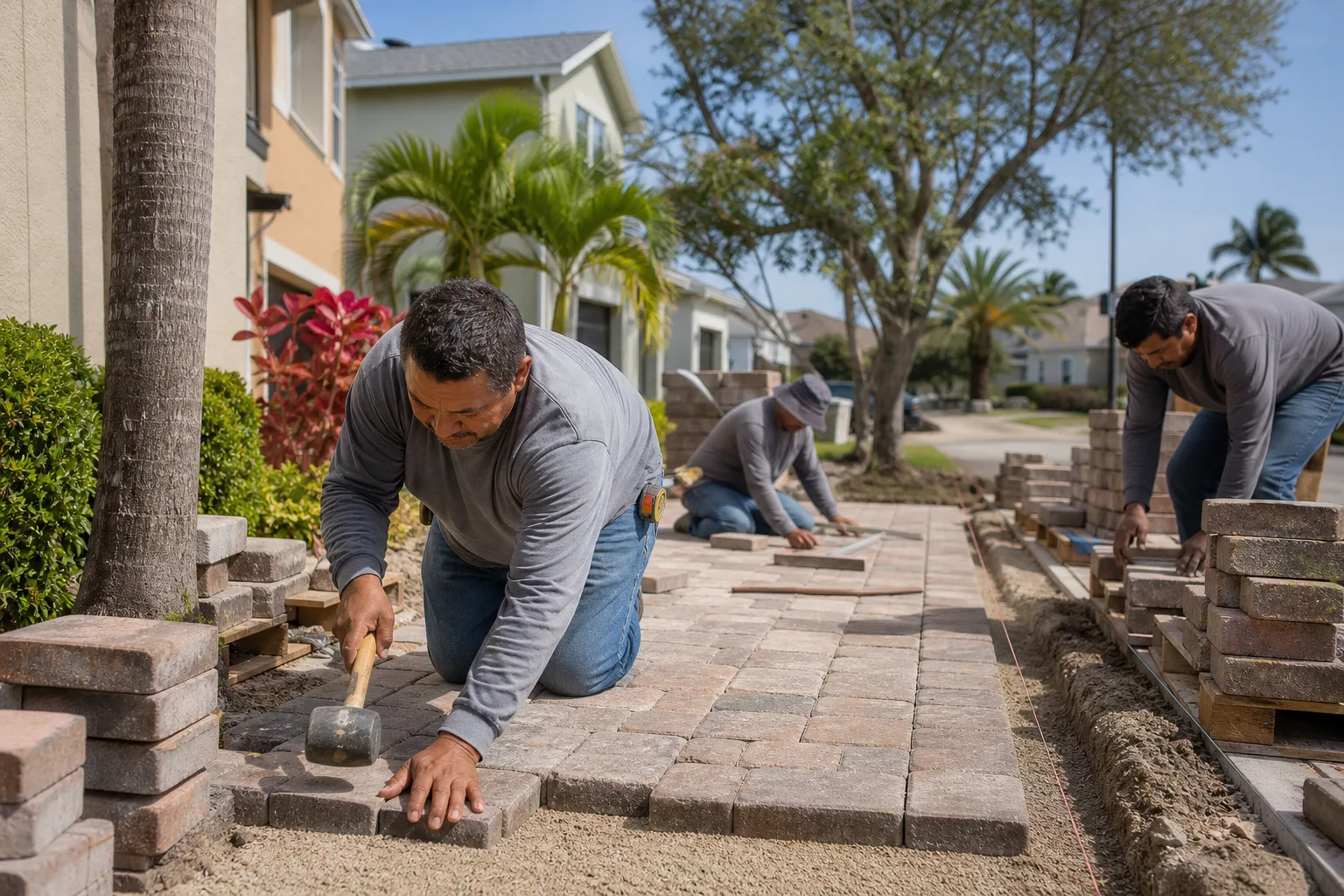
Some driveway issues are honest DIY fixes – a re-sand, a downspout extension, a weed pulled from a joint. Others are the point at which a professional should be standing on the driveway with you. Call us when: a paver rocks underfoot or under tire load; water pools in the same spot after every rain and stays for a day or more; a joint has washed out more than half an inch; the edge restraint cracks or bows; pavers crack or heave; water runs toward the garage; or the driveway has visible sunken sections greater than two inches deep. Any one of those signs is a signal that the base underneath is no longer doing its job, and the cost of the repair grows every month it’s deferred.
Groundwork Construction Co. of Westchester offers free estimates on every driveway and paver job in Westchester – call (833) 630-4214. Our technicians arrive background-checked and in uniform, and we hand you a written, upfront pricing estimate before any work starts. Every project is backed by our 730-Day Done Right Promise, which means if the workmanship fails within that window, we make it right. Calls are answered by a live person 24 hours a day, every day. You don’t need to wait until Monday morning to ask about the water pooling in your driveway.
For a full view of what a driveway rebuild looks like when we handle it from grading to top course, see our Driveway & Pavers in Westchester page. For the broader scope of what Groundwork Construction Co. of Westchester handles – from kitchens to roofing to pavers – see our home page.
Frequently Asked Questions
If the pavers themselves are intact and the sunken area is small and isolated, re-leveling is usually the answer: you pull the affected pavers, re-establish the bedding sand, re-set the pavers, and re-sand the joints. If the pavers are cracked, if the sink is more than two pavers wide, or if a truck has already broken pavers at the low spot, you’re probably looking at a base repair under that section. A free estimate from Groundwork Construction Co. of Westchester will tell you honestly which category your driveway is in. Call (833) 630-4214.
Because the root cause is on the other side of the joints. Weeds grow where the joint sand has washed out and the base has stayed wet long enough to support plant life. Pulling the weed clears the surface; re-sanding the joints and correcting the drainage path underneath is what stops the cycle. If the weeds are concentrated in a band or cluster rather than scattered randomly, that’s a drainage issue, not a seed issue. Call (833) 630-4214 for a free estimate.
Not necessarily. Rocking at the edge usually means the edge restraint needs repair – a targeted fix that often costs a fraction of replacement. Rocking in the middle of the field usually means the bedding sand has washed out under that area. Both are fixable without replacing the whole driveway if caught before pavers crack. Our technicians have up to 12 years of experience diagnosing which is which on site. Call for a free estimate.
Typical residential ranges in the Westchester market run from around $150 – $400 for a single-paver leveling and re-sand, $400 – $1,200 for a clustered section repair with re-bedding, $1,500 – $3,500 for edge-restraint repair plus partial base rebuild, and $8,000 – $18,000 for a partial or full driveway replacement depending on square footage and subgrade correction. Call (833) 630-4214 for an exact quote – estimates are free and upfront in writing.
Yes for most cases. Westchester requires a permit for driveway replacement, driveway widening, and any work in the right-of-way between the sidewalk and the street. The town also cares about drainage discharge onto neighboring properties. We pull the permit for you as part of every project that needs one, and we build the drainage plan into the estimate before we start. If a contractor tells you a Westchester driveway replacement doesn’t need a permit, that’s worth a second opinion. Call (833) 630-4214.
Three signs mean call now: water pooling against the garage door or house, pavers heaved high enough that a car tire has broken one, and water visibly running onto a neighbor’s property or your foundation. Anything else – a single rocking paver, a low spot that collects water and drains within a day, an expanding joint – is worth scheduling soon but isn’t a same-day emergency. Live person answers 24/7 at (833) 630-4214 if you’re not sure which category you’re in.
The Bottom Line

Driveways rarely fail without warning. Directional sinking, rocking pavers, weeds pushing through joints, and pooling water in the same spot after every rain are all your base layer telling you something – and every month you wait, the repair gets bigger and more expensive. Westchester’s flat grade, high water table, and muck-and-limestone soil make those warnings show up here sooner and more clearly than they do in most of South Florida. Read them honestly, fix them at the earliest stage, and the driveway you have will last another decade or two. Ignore them and it won’t.
When you’re ready to know what stage your driveway is at, call Groundwork Construction Co. of Westchester at (833) 630-4214 for a free estimate. No-hassle upfront pricing, a written quote in the number you pay, 0% financing for 18 months available, and $1,000 off any project over $10,000. Estimates are free and there’s a live person on the line any hour, any day.
Written by the team at Groundwork Construction Co. of Westchester.